PANDA at FAIR
The PANDA experiment will be one of the future experiments at the Facility for Antiproton and Ion Research (FAIR).
PANDA research focuses on the study of hadron spectroscopy, exotic hadrons, the structure of nucleons and the properties of hadrons in general. PANDA's high-energy storage ring utilizes antiprotons produced by high-intensity proton collisions with a copper target and enables collisions with a fixed target in its advanced detector system. This setup is designed to capture a wide range of phenomena, from the behavior of quarks and gluons to the formation and properties of exotic particles.
The PANDA detector promises almost complete solid angle coverage, high-resolution tracking, efficient particle identification and precise energy and momentum measurements. This versatility will be made possible by the PANDA collaboration, a team of over 450 scientists from 17 countries.
One main part of the PANDA detector is the electromagnetic calorimeter, which consists of the barrel and the forward as well as backward endcap. The AG Thoma is involved in the development of the forward endcap EMC which is currently in the pahse of beeing built up. The forward endcap consists of 3856 lead tungstate crystals of second generation, which are grouped into detector submodules with 8/16 crystals each. A big challenge is the operation of the detector at a temperature of -25°C, which is necessary to increase the light yield of the crystals to ensure the dynamic energy range of 3MeV to 12GeV. Due to the fact that the PANDA-experiment is a fixed target experiment and a high particle rate is expected in forward direction and the influence of the magnetic field, two different photon readouts are used. These are on the one hand the VPTTs (vacuum photo tetrodes) in the inner and the APDs (avalanche photodiodes) in the outer region used. The signals are processed using sampling ADCs, which extract timing and energy information of the captured waveform online.
In order to built such a complex detector, many steps starting from hardware development towards building up the detector are necessary. Therefore, our group is involved in different tasks in cooperation with our collegues from the Ruhr University at Bochum.
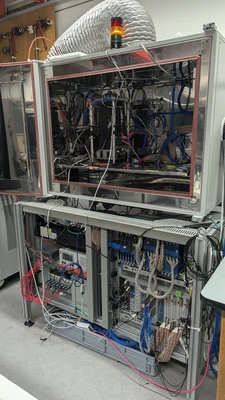
After the detector submodules are produced, they must undergo extensive tests to ensure the full functionality of all components. In addition to that an energy pre-calibration is performed inside a temperature chamber under the target temperature of -25°C using cosmic particles. For this purpose a dedicated and full automatized teststation was developed. In addition, special high voltage distribution boards were developed and produced to ensure an individual and precise high voltage supply for all APDs. With a high precision laser tracker, we perform position measurements during the production of the detector modules and after the build up of the detector to ensure that the small tolerances are met and to use the actual geometry of the detector for even more realitic simulations ins the future.